what is the largest contributor to greenhouse gases

United states EPA
U.s.a. Ecology Protection Agency
Greenhouse Gas Emissions
Sources of Greenhouse Gas Emissions
Overview
* 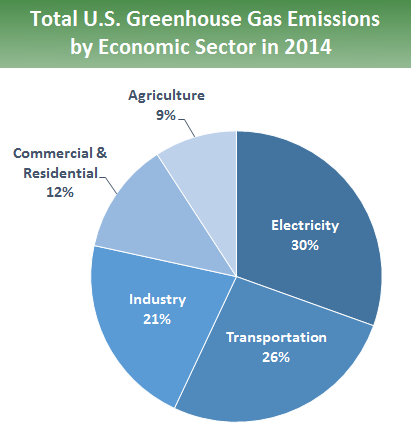 Total Emissions in 2014 = six,870 Meg Metric Tons of COiiequivalent
Greenhouse gases trap heat and brand the planet warmer. Human activities are responsible for most all of the increase in greenhouse gases in the atmosphere over the last 150 years.1 The largest source of greenhouse gas emissions from human activities in the United States is from called-for fossil fuels for electricity, oestrus, and transportation.
EPA tracks full U.S. emissions by publishing the Inventory of U.South. Greenhouse Gas Emissions and Sinks. This annual report estimates the full national greenhouse gas emissions and removals associated with human being activities across the U.s.a..
The primary sources of greenhouse gas emissions in the United States are:
- (xxx pct of 2014 greenhouse gas emissions) – Electricity production generates the largest share of greenhouse gas emissions. Approximately 67 percent of our electricity comes from called-for fossil fuels, by and large coal and natural gas.2
- (26 percent of 2014 greenhouse gas emissions) – Greenhouse gas emissions from transportation primarily come up from called-for fossil fuel for our cars, trucks, ships, trains, and planes. Over 90 percent of the fuel used for transportation is petroleum based, which includes gasoline and diesel.3
- (21 percent of 2014 greenhouse gas emissions) – Greenhouse gas emissions from industry primarily come up from burning fossil fuels for energy, as well as greenhouse gas emissions from certain chemical reactions necessary to produce goods from raw materials.
- (12 percent of 2014 greenhouse gas emissions) – Greenhouse gas emissions from businesses and homes arise primarily from fossil fuels burned for heat, the use of certain products that contain greenhouse gases, and the handling of waste matter.
- (9 per centum of 2014 greenhouse gas emissions) – Greenhouse gas emissions from agriculture come from livestock such as cows, agronomical soils, and rice product.
- (kickoff of eleven pct of 2014 greenhouse gas emissions) – Land areas can act as a sink (arresting COii from the atmosphere) or a source of greenhouse gas emissions. In the United States, since 1990, managed forests and other lands have captivated more CO2 from the atmosphere than they emit.
Emissions and Trends
Since 1990, U.S. greenhouse gas emissions have increased by virtually vii percent. From year to year, emissions can ascent and autumn due to changes in the economic system, the toll of fuel, and other factors. In 2014, U.S. greenhouse gas emissions increased compared to 2013 levels. This increase was due to a number of factors, including: common cold wintertime conditions resulting in an increment in fuel demand, especially in residential and commercial sectors; an increase in transportation emissions resulting from an increase in vehicle miles traveled; and an increment in industrial product across multiple sectors that as well resulted in increases in industrial sector emissions.
Larger epitome to relieve or print.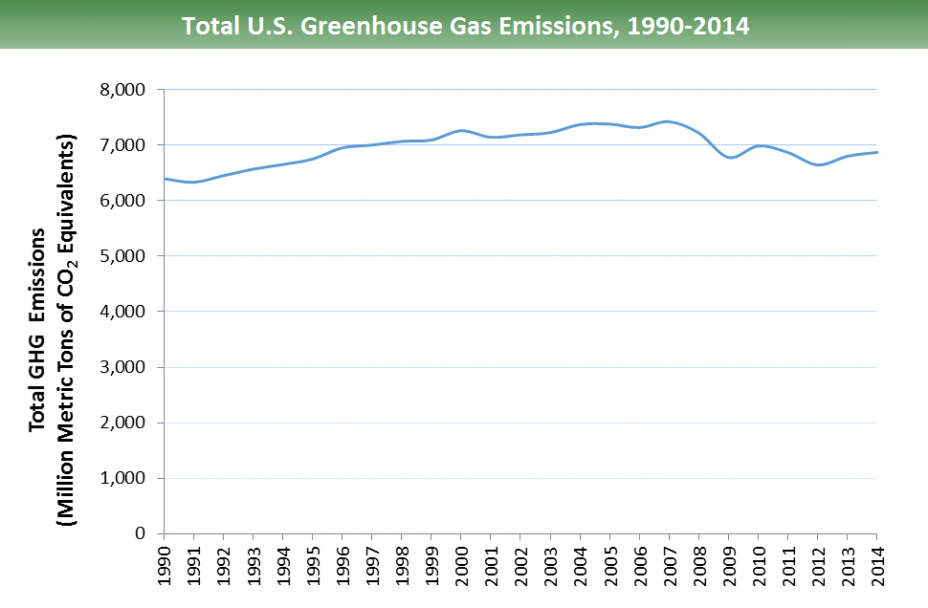 All emission estimates from theInventory of U.S. Greenhouse Gas Emissions and Sinks: 1990–2014.
To learn about projected greenhouse gas emissions to 2020, visit the U.S. Climate Action Report 2014. (310 pp, 23 M, About PDF)
References
1 IPCC (2007). Summary for Policymakers. In: Climate change 2007: The Concrete Science Basis.Exit Contribution of Working Grouping I to the Fourth Cess Study of the Intergovernmental Panel on Climatic change [Solomon, South., D. Qin, Yard. Manning, Z. Chen, Yard. Marquis, Grand.B. Averyt, Yard. Tignor and H.L. Miller (eds.)]. Cambridge University Press, Cambridge, United Kingdom and New York, NY, U.s.a..
2 U.S. Energy Information Administration (2016). Electricity Explained - Basics.
3 Kahn Ribeiro, S., S. Kobayashi, One thousand. Beuthe, J. Gasca, D. Greene, D. S. Lee, Y. Muromachi, P. J. Newton, S. Plotkin, D. Sperling, R. Wit, P. J. Zhou (2007). Transport and its infrastructure. In Climate Change 2007: Mitigation.Exit Contribution of Working Group III to the Fourth Assessment Study of the Intergovernmental Console on Climate Alter [B. Metz, O.R. Davidson, P.R. Bosch, R. Dave, 50.A. Meyer (eds.)], Cambridge University Press, Cambridge, United kingdom.
Top of Folio
Electricity Sector Emissions
* Larger image to save or print.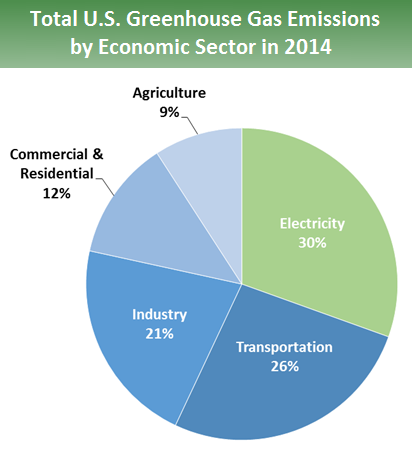 Full Emissions in 2014 = vi,870 One thousand thousand Metric Tons of CO2equivalent
Greenhouse Gas Emissions in the Electricity Sector by Fuel Source
Coal combustion is generally more carbon intensive than burning natural gas or petroleum for electricity. Although coal accounts for about 77 percent of COtwo emissions from the sector, it represents nearly 39 percent of the electricity generated in the Usa. About 27 percent of electricity generated in 2014 was generated using natural gas, an increase relative to 2013. Petroleum accounts for approximately 1 percentage of electricity generation. The remaining generation comes from nuclear (about nineteen percent) and renewable sources (about 13 percent), which include hydroelectricity, biomass, wind, and solar.1 These other sources unremarkably release fewer greenhouse gas emissions than fossil fuel combustion, if any emissions at all.
Emissions and Trends
In 2014, the electricity sector was the largest source of U.S. greenhouse gas emissions, bookkeeping for about xxx percent of the U.S. total. Greenhouse gas emissions from electricity have increased by about 12 percent since 1990 as electricity demand has grown and fossil fuels have remained the dominant source for generation.
To larn about projected greenhouse gas emissions to 2020, visit theU.S. Climate Activity Report 2014 (310 pp, 23 K, About PDF).
Larger paradigm to save or print.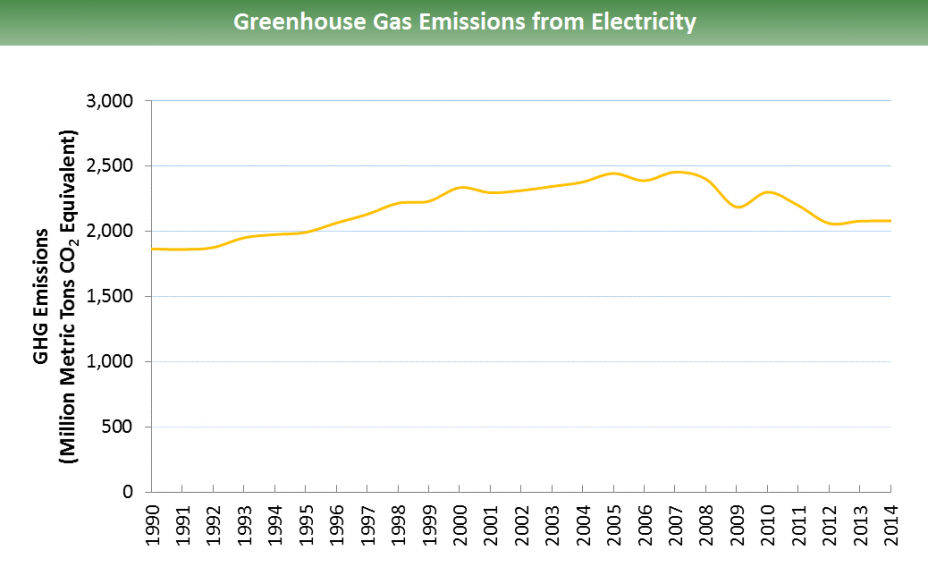 Annotation: All emission estimates from theInventory of U.Southward. Greenhouse Gas Emissions and Sinks: 1990–2014.
Greenhouse Gas Emissions by Electricity Terminate-Use
Larger paradigm to save or print.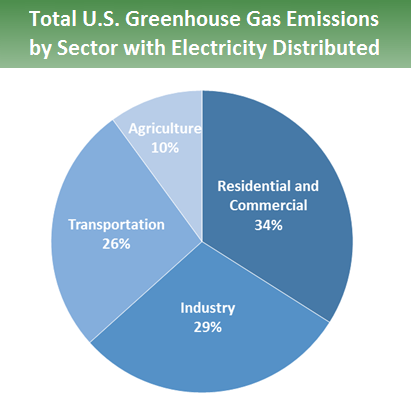 Annotation: All emission estimates from theInventory of U.S. Greenhouse Gas Emissions and Sinks: 1990–2014.
When emissions from electricity are allocated to the cease-use sector, industrial activities business relationship for a much larger share of U.S. greenhouse gas emissions. Emissions from commercial and residential buildings likewise increase substantially when emissions from electricity are included, due to their relatively large share of electricity consumption (due east.yard., lighting and appliances).
Reducing Emissions from Electricity
In that location are a diverseness of opportunities to reduce greenhouse gas emissions associated with electricity generation, transmission, and distribution. The tabular array shown below categorizes these opportunities and provides examples. For a more than comprehensive list, see Chapter 7 of theContribution of Working Group III to the Fifth Assessment Study of the Intergovernmental Panel on Climate Modify. Exit
Under the president's Climate Activeness Plan, EPA is taking action to reduce emissions from power plants.Learn More.
| Type | How Emissions Are Reduced | Examples |
|---|---|---|
| Increased Efficiency of Power Plants and Fuel Switching | Increasing efficiency of existing power plants by using avant-garde technologies or substituting fuels that combust more efficiently. |
|
| Renewable Energy | Using renewable energy sources rather than fossil fuel to generate electricity. | Increasing the share of total electricity generated from air current, solar, hydro, and geothermal sources and from certain biofuel sources. |
| Increased Energy Efficiency (end-apply) | Reducing free energy demand by increasing efficiency and conservation in homes, businesses, and industry. | EPA's ENERGY STAR® partners removed over 300 million metric tons of greenhouse gases in 2014 alone, and saved consumers and businesses over $34 billion on their utility bills. |
| Nuclear Energy | Generating electricity from nuclear processes rather than the combustion of fossil fuels. | Edifice nuclear power plants equally fossil fuel power plants are retired. |
| Carbon Capture Sequestration and Storage (CCS) | Capturing CO2 as a byproduct of fossil fuel combustion before it enters the temper and and then transferring the COtwo to a long-term storage area, such as an underground geologic formation. | Capturing CO2 from the stacks of a coal-fired power plant, and then transferring the CO2 via pipeline to a nearby abandoned oil field where the CO2 is injected underground. Larn more near CCS. |
Reference
i. U.S. Energy Information Administration (2014). Electricity Explained - Basics.
Top of Page
Transportation Sector Emissions
* Larger image to salve or print.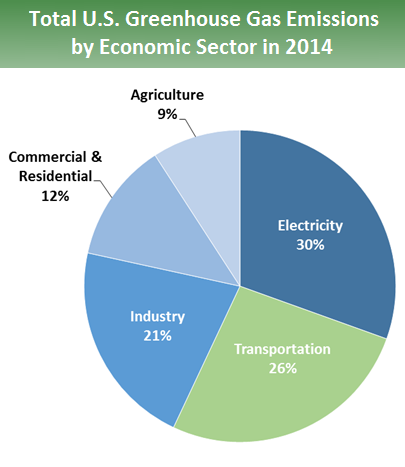 Total Emissions in 2014 = 6,870 Meg Metric Tons of CO2 equivalent
Relatively small amounts of methane (CH4) and nitrous oxide (NorthwardiiO) are emitted during fuel combustion. In addition, a modest amount of hydrofluorocarbon (HFC) emissions are included in the Transportation sector. These emissions effect from the use of mobile air conditioners and refrigerated transport.
Emissions and Trends
In 2014, greenhouse gas emissions from transportation deemed for near 26 percent of total U.S. greenhouse gas emissions, making it the 2d largest contributor of U.S. greenhouse gas emissions after the . Greenhouse gas emissions from transportation accept increased by about 17 percent since 1990. This historical increase is largely due to increased demand for travel and the limited gains in fuel efficiency across the U.S. vehicle fleet. The number of vehicle miles traveled by passenger cars and light-duty trucks increased 37 per centum from 1990 to 2014. The increase in travel miles is attributed to several factors, including population growth, economic growth, urban sprawl, and low fuel prices during the first of this period. Between 1990 and 2004, average fuel economic system among new vehicles sold annually declined, as sales of light-duty trucks increased. However, new vehicle fuel economy began to amend in 2005, largely due to a lower light-duty truck market share and higher fuel economy standards.
Learn more most Greenhouse Gas Emissions from Transportation. To learn near projected greenhouse gas emissions to 2020, visit theU.South. Climate Activeness Report 2014 (310 pp, 23 K, About PDF).
Larger prototype to relieve or print.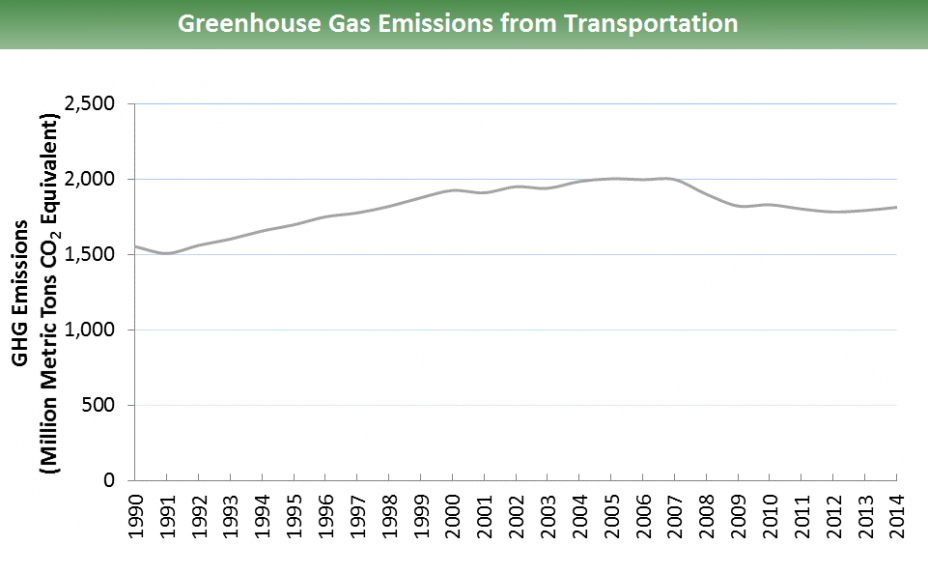 Notation: Emissions involved in the consumption of electricity for transportation activities are included above, but not shown separately (equally was done for other sectors). These indirect emissions are negligible, bookkeeping for less than 1 pct of the total emissions shown in the graph.
Note: All emission estimates from theInventory of U.S. Greenhouse Gas Emissions and Sinks: 1990–2014.
Reducing Emissions from Transportation
There are a diversity of opportunities to reduce greenhouse gas emissions associated with transportation. The tabular array shown below categorizes these opportunities and provides examples. For a more than comprehensive list, run across Affiliate 8 of theContribution of Working Grouping III to the Fifth Assessment Report of the Intergovernmental Console on Climate change. Get out
EPA's vehicle greenhouse gas rules volition salvage consumers $1.7 trillion at the pump past 2025, and eliminate half dozen billion metric tons of greenhouse gas pollution.
| Type | How Emissions Are Reduced | Examples |
|---|---|---|
| Fuel Switching | Using fuels that emit less CO2 than fuels currently being used. Alternative sources can include biofuels; hydrogen; electricity from renewable sources, such as air current and solar; or fossil fuels that are less CO2-intensive than the fuels that they replace. Larn more virtually Alternative and Renewable Fuels. |
|
| Improving Fuel Efficiency with Advanced Blueprint, Materials, and Technologies | Using advanced technologies, pattern, and materials to develop more fuel-efficient vehicles. Learn about EPA's vehicle greenhouse gas rules. |
|
| Improving Operating Practices | Adopting practices that minimize fuel use. Improving driving practices and vehicle maintenance. Learn nearly how the freight transportation industry can reduce emissions through EPA's SmartWay Program. |
|
| Reducing Travel Demand | Employing urban planning to reduce the number of miles that people drive each day. Acquire about EPA's Smart Growth Plan. Reducing the need for driving through travel efficiency measures such as commuter, biking, and pedestrian programs. |
|
Acme of Page
Manufacture Sector Emissions
* Larger prototype to relieve or print.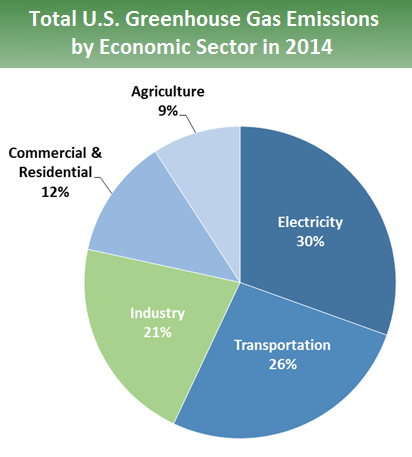 Full Emissions in 2014 = 6,870 Million Metric Tons of CO2 equivalent
Direct emissions are produced by burning fuel for power or estrus, through chemical reactions, and from leaks from industrial processes or equipment. Most direct emissions come up from the consumption of fossil fuels for energy. A smaller amount, roughly a third, come up from leaks from natural gas and petroleum systems, the use of fuels in product (due east.thousand., petroleum products used to make plastics), and chemical reactions during the production of chemicals, iron and steel, and cement.
Indirect emissions are produced past burning fossil fuel at a ability plant to make electricity, which is and so used by an industrial facility to power industrial buildings and machinery.
More data almost facility-level emissions from big industrial sources is bachelor through EPA'southward Greenhouse Gas Reporting Program'southward data publication tool. National-level information about emissions from industry equally a whole tin can exist found in the sections on Fossil Fuel Combustion and the Industrial Processes chapter in the Inventory of U.S. Greenhouse Gas Emissions and Sinks.
Emissions and Trends
In 2014, direct industrial greenhouse gas emissions deemed for approximately 21 percentage of total U.Southward. greenhouse gas emissions, making it the tertiary largest contributor to U.S. greenhouse gas emissions, later on the and sectors. If both direct and indirect emissions associated with electricity utilise are included, industry's share of total U.S. greenhouse gas emissions in 2014 was 29 percent, making it the largest contributor of greenhouse gases of any sector. Greenhouse gas emissions from manufacture accept declined by near 10 percent since 1990, while emissions from nearly other sectors have increased.
To learn about projected greenhouse gas emissions to 2020, visit the U.S. Climate Action Report 2014. (310 pp, 23 M, Nigh PDF)
Larger image to save or print.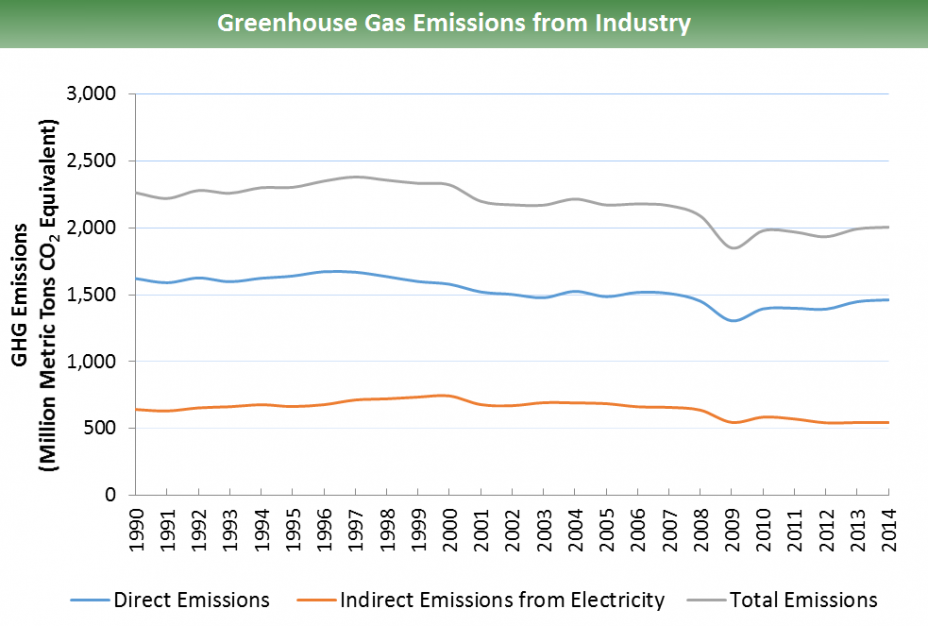 All emission estimates from the Inventory of U.S. Greenhouse Gas Emissions and Sinks: 1990–2014.
Reducing Emissions from Industry
There are a wide multifariousness of industrial activities that cause greenhouse gas emissions, and many opportunities to reduce them. The table shown below provides some examples of opportunities for industry to reduce emissions. For a more than comprehensive listing, encounter Affiliate 10 of the Contribution of Working Group III to the Fifth Assessment Written report of the Intergovernmental Panel on Climate Modify. Exit
| Type | How Emissions Are Reduced | Examples |
|---|---|---|
| Free energy Efficiency | Upgrading to more efficient industrial technology. EPA'south ENERGY STAR® programme helps industries get more energy-efficient. | Identifying the ways that manufacturers(87 pp, 1 M, About PDF) can use less energy to light and heat factories or to run equipment. |
| Fuel Switching | Switching to fuels that event in less CO2 emissions simply the same amount of energy, when combusted. | Using natural gas instead of coal to run machinery. |
| Recycling | Producing industrial products from materials that are recycled or renewable, rather than producing new products from raw materials. | Using flake steel and bit aluminum as opposed to smelting new aluminum or forging new steel. |
| Training and Awareness | Making companies and workers enlightened of the steps to reduce or prevent emissions leaks from equipment. | Instituting handling policies and procedures for perfluorocarbons (PFCs), hydrofluorocarbons (HFCs), and sulfur hexafluoride (SFhalf dozen) that reduce occurrences of accidental releases and leaks from containers and equipment. |
Top of Folio
Commercial and Residential Sector Emissions
* Larger image to save or impress.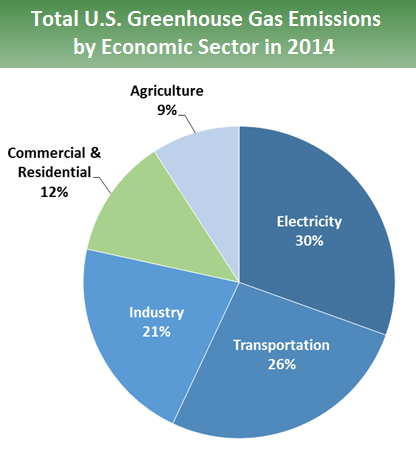 Full Emissions in 2014 = 6,870 Million Metric Tons of CO2 equivalent
Residential and commercial activities contribute to emissions in a variety of ways:
- Combustion of natural gas and petroleum products for heating and cooking needs emits carbon dioxide (COtwo), methane (CH4), and nitrous oxide (N2O). Emissions from natural gas consumption correspond about 81 percentage of the straight fossil fuel COii emissions from the residential and commercial sectors. Coal consumption is a minor component of energy use in both of these sectors.
- Organic waste sent to landfills emits CH4.
- Wastewater treatment plants emit CH4 and NiiO.
- Fluorinated gases (mainly hydrofluorocarbons, or HFCs) used in ac and refrigeration systems tin be released during servicing or from leaking equipment.
More than national-level information well-nigh emissions from the residential and commercial sectors tin be institute in the U.S. Inventory'due south Free energy and Trends chapters.
Emissions and Trends
In 2014, direct greenhouse gas emissions from homes and businesses deemed for approximately 12 percent of total U.Due south. greenhouse gas emissions. Greenhouse gas emissions from homes and businesses have mostly been increasing since 1990, but vary from year to year based on brusk-term fluctuations in energy consumption acquired past weather atmospheric condition. Full residential and commercial greenhouse gas emissions in 2014 have increased by nearly 11 percent since 1990. Greenhouse gas emissions from on-site energy combustion in homes and businesses have increased by about 11 percent since 1990. Additionally, indirect emissions from employ by homes and businesses have increased by 27 pct since 1990, due to increasing electricity consumption for lighting, heating, air-conditioning, and appliances.
To larn about projected greenhouse gas emissions to 2020, visit the U.S. Climate Activity Report 2014. (310 pp, 23 M, About PDF)
Larger image to salve or print.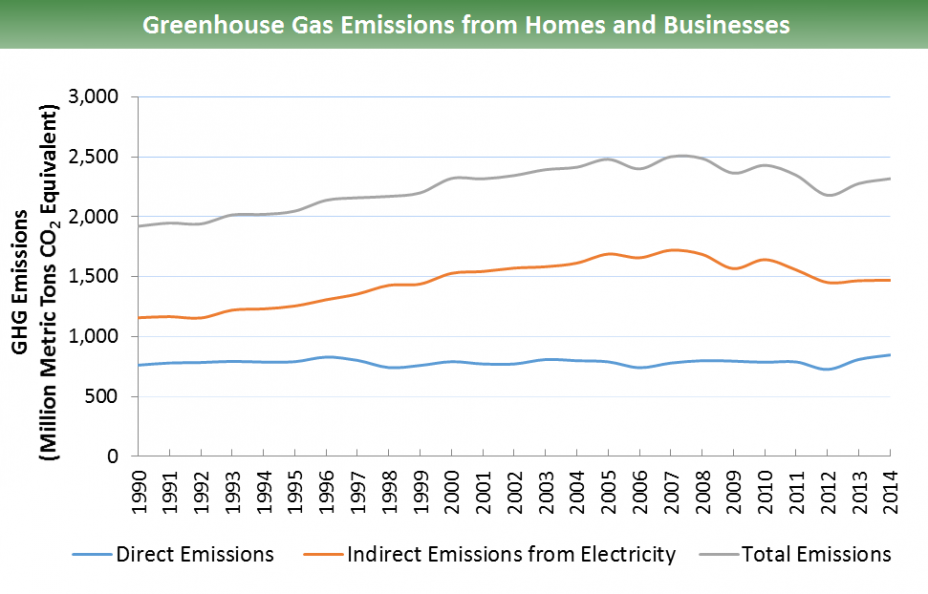 All emission estimates from the Inventory of U.South. Greenhouse Gas Emissions and Sinks: 1990–2014.
Reducing Emissions from Homes and Businesses
The tabular array shown below provides some examples of opportunities to reduce emissions from homes and businesses. For a more than comprehensive list of options and a detailed assessment of how each choice affects dissimilar gases, see Chapter 9 and Chapter 12 of the Contribution of Working Group III to the Fifth Assessment Report of the Intergovernmental Console on Climate change. Go out
| Type | How Emissions Are Reduced | Examples |
|---|---|---|
| Homes and Commercial Buildings | Reducing energy use through energy efficiency. | Homes and commercial buildings employ large amounts of energy for heating, cooling, lighting, and other functions. "Green building" techniques and retrofits can allow new and existing buildings to use less energy to attain the aforementioned functions, leading to fewer greenhouse gas emissions. Techniques to amend building free energy efficiency include better insulation; more than energy-efficient heating, cooling, ventilation, and refrigeration systems; efficient fluorescent lighting; passive heating and lighting to take advantage of sunlight; and the buy of energy-efficient appliances and electronics. Larn more about ENERGY STAR®. |
| Wastewater Treatment | Making water and wastewater systems more energy-efficient. | Drinking water and wastewater systems account for approximately 3 percentage to 4 percent of energy use in the United States. Studies estimate potential savings of 15 percent to xxx percent that are "readily achievable" in water and wastewater plants.1 Learn more most Energy Efficiency for H2o and Wastewater Utilities. |
| Waste Management | Reducing solid waste material sent to landfills. Capturing and using methane produced in current landfills. | Landfill gas is the natural byproduct of the decomposition of solid waste in landfills. It primarily consists of COii and CH4. Well established, low-cost methods to reduce greenhouse gases from consumer waste exist, including recycling programs, waste matter reduction programs, and landfill methane capture programs.
|
| Refrigeration | Reducing leakage from refrigeration equipment. Using refrigerants with lower global warming potentials. | Commonly used refrigerants include ozone-depleting hydrochlorofluorocarbon (HCFC) refrigerants, frequently HCFC-22, and blends consisting entirely or primarily of hydrofluorocarbons (HFCs), both of which are potent greenhouse gases. In recent years there have been several advancements in refrigeration technology that tin can assistance food retailers reduce both refrigerant charges and refrigerant emissions. Learn more nearly EPA's GreenChill Programme to reduce greenhouse gas emissions from commercial refrigerators. |
References
1 EPA (2012). Energy Efficiency for H2o and Wastewater Utilities. Accessed 03/thirteen/2012
Height of Page
Agriculture Sector Emissions
* 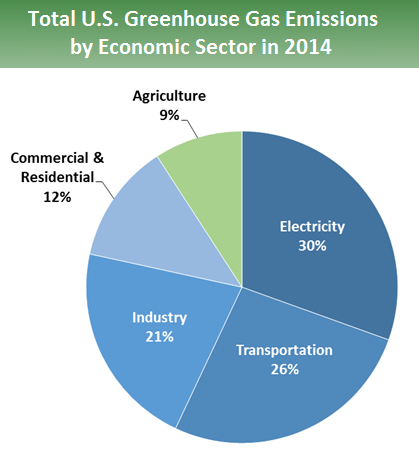 Total Emissions in 2014 = six,870 1000000 Metric Tons of COtwo equivalent
Agricultural activities – the tillage of crops and livestock for food – contribute to emissions in a variety of ways:
- Various management practices for agricultural soils tin atomic number 82 to production and emission of nitrous oxide (NtwoO). The large number of different activities that can contribute to North2O emissions from agronomical lands range from fertilizer awarding to methods of irrigation and tillage. Management of agronomical soils accounts for over half of the emissions from the Agronomics sector.*
- Livestock, specially cattle, produce methane (CH4) equally role of their digestion. This process is called enteric fermentation, and it represents almost 1 third of the emissions from the Agriculture sector.
- The way in which manure from livestock is managed likewise contributes to CH4 and N2O emissions. Manure storage methods and the amount of exposure to oxygen and wet can affect how these greenhouse gases are produced. Manure management accounts for about xiv percent of the total greenhouse gas emissions from the Agronomics sector in the United States.
- Smaller sources of emissions include rice cultivation, which produces CH4, and burning crop residues, which produce CH4 and N2O.
More national-level information well-nigh emissions from agronomics tin be found in the agriculture chapter in the Inventory of U.South. Greenhouse Gas Emissions and Sinks.
* Management of agricultural soils tin also pb to emissions of carbon dioxide (CO2). However, these emissions are included nether the .
Emissions and Trends
In 2014, greenhouse gas emissions from agriculture accounted for approximately 9 pct of total U.S. greenhouse gas emissions. Greenhouse gas emissions from agriculture have increased by approximately eleven percent since 1990. One driver for this increase has been the 54 percentage growth in combined CH4 and N2O emissions from livestock manure direction systems, reflecting the increased apply of emission-intensive liquid systems over this time period. Emissions from agricultural soil management have also increased by about five percent since 1990. Emissions from other agricultural sources take either remained flat or changed by a relatively small amount since 1990.
To learn nearly projected greenhouse gas emissions to 2020, visit the U.S. Climate Action Report 2014. (310 pp, 23 M, Near PDF)
Larger epitome to save or print.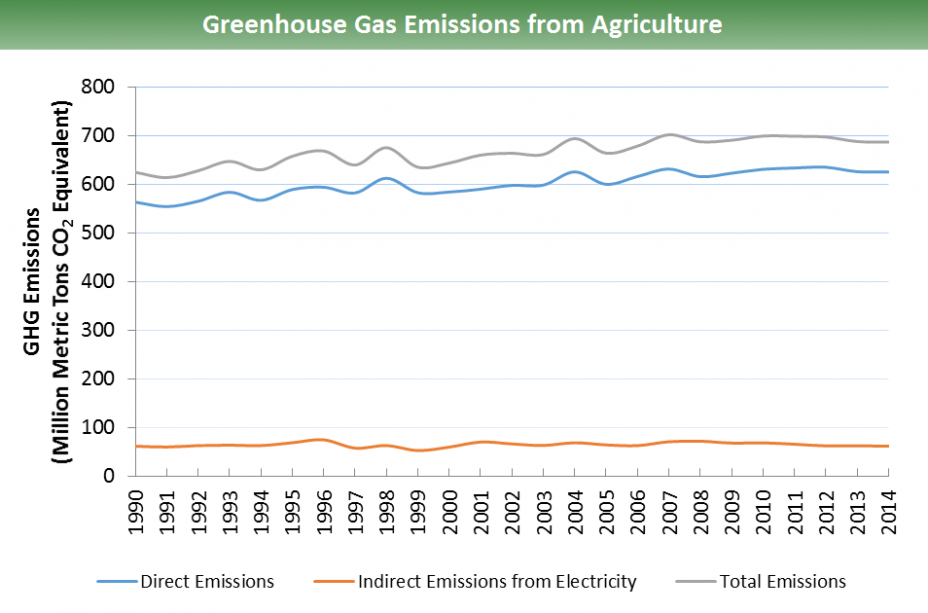 All emission estimates from the Inventory of U.S. Greenhouse Gas Emissions and Sinks: 1990–2014.
Reducing Emissions from Agriculture
The table shown below provides some examples of opportunities to reduce emissions from agriculture. For a more comprehensive list of options and a detailed assessment of how each option affects different gases, see Affiliate 11 of the Contribution of Working Group III to the Fifth Assessment Report of the Intergovernmental Panel on Climate Change. Leave
| Type | How Emissions Are Reduced | Examples |
|---|---|---|
| Land and Crop Management | Adjusting the methods for managing land and growing crops. |
|
| Livestock Management | Adjusting feeding practices and other management methods to reduce the amount of CH4 resulting from enteric fermentation. | Improving pasture quality to increase animal productivity, which can reduce the amount of CHiv emitted per unit of fauna product. Too, increased productivity can be accomplished through breeding. |
| Manure Direction |
|
|
Top of Page
Land Use, Land-Apply Alter, and Forestry Sector Emissions
Plants absorb carbon dioxide (CO2) from the atmosphere as they grow, and they shop some of the carbon throughout their lifetime. Soils can too store COii, depending on how the soil is managed. This storage of carbon in plants and soils is called biological carbon sequestration. Because biological sequestration takes COtwo out of the atmosphere, it is besides called a greenhouse gas "sink."
Emissions or sequestration of CO2 can occur as land uses modify. For case, COii is exchanged between the atmosphere and the plants and soils on country equally quondam cropland is converted into grassland, as new areas are cultivated and get cropland, or as forests abound. In improver, using biological feedstocks (such equally energy crops or wood) for purposes such as electricity generation, input to processes that create liquid fuels, or building materials can lead to emissions or sequestration.
In the United States overall, since 1990, land utilise, land-apply alter, and forestry activities have resulted in more removal of CO2 from the atmosphere than emissions. Considering of this, the State Utilise, Land-Use Alter, and Forestry (LULUCF) sector in the United States is considered a cyberspace sink, rather than a source, of CO2 over this menses. In many areas of the world, the opposite is true: In countries where large areas of forest country are cleared, often for agricultural purposes or for settlements, the LULUCF sector can exist a net source of greenhouse gas emissions.
- More national-level data about land use, land-use change, and forestry is available from the Land Employ, State-Use Change, and Forestry affiliate in the Inventory of U.S. Greenhouse Gas Emissions and Sinks.
- See EPA'southward Global Greenhouse Gas emissions page for more information almost global greenhouse gas emissions from land use and forestry activities.
- For more data near global emissions from land utilise and forestry activities, encounter the Contribution of Working Group Iii to the Fifth Assessment Report of the Intergovernmental Panel on Climate Change. Exit
Emissions and Trends
In 2014, the net CO2 removed from the atmosphere from the LULUCF sector offset about 11 percent of full U.S. greenhouse gas emissions. Forests (including vegetation, soils, and harvested wood) accounted for approximately 87 percent of the total 2014 LULUCF CO2 removals.
The net carbon sequestration by the LULUCF sector has increased by well-nigh 5 percent since 1990, largely every bit a result of changes in the land area of forests and improved woods management.
To learn about projected greenhouse gas emissions to 2020, visit the U.South. Climate Action Report 2014. (310 pp, 23 1000, About PDF)
Larger epitome to save or print.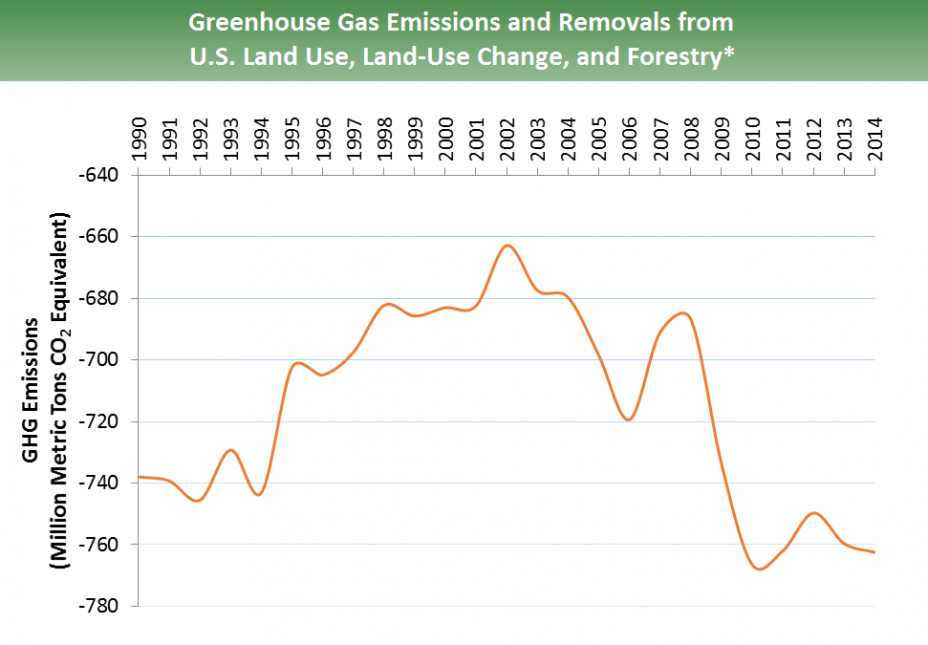 *Note: The LULUCF sector is a net "sink" of emissions in the United States (due east.1000., more than greenhouse gas emissions are sequestered than emitted from land use activities), so net greenhouse gas emissions from LULUCF are negative.
All emission estimates from the Inventory of U.S. Greenhouse Gas Emissions and Sinks: 1990–2014.
Reducing Emissions and Enhancing Sinks from State Use, State-Use Change, and Forestry
In the LULUCF sector, opportunities exist to reduce emissions and increase the potential to sequester carbon from the atmosphere by enhancing sinks. The tabular array shown below provides some examples of opportunities for both reducing emissions and enhancing sinks. For a more comprehensive list, see Chapter 11 of the Contribution of Working Grouping III to the 5th Assessment Report of the Intergovernmental Console on Climate change. Exit
| Type | How Emissions Are Reduced or Sinks Are Enhanced Examples | Examples |
|---|---|---|
| Change in Uses of Land | Increasing carbon storage by using state differently or maintaining carbon storage by fugitive land degradation. |
|
| Changes in State Management Practices | Improving management practices on existing country-use types. |
|
Pinnacle of Folio
Source: https://climatechange.chicago.gov/ghgemissions/sources-greenhouse-gas-emissions
0 Response to "what is the largest contributor to greenhouse gases"
Postar um comentário